

Launching a real money poker app platform in 2026 is significantly easier than it was a decade ago.
Technology has matured. White label solutions have become more reliable. Cloud infrastructure is readily available. Mobile-first player behaviour has become the norm.
However, many poker projects still fail.
Surprisingly, the reasons are often not technical.
Operators spend years building technology before validating demand. They underestimate the importance of community building. They overinvest in features before understanding player behaviour. Some never make it to market.
Launching a successful poker platform is no longer just a technology challenge. It is a business execution challenge.
This guide outlines the key decisions operators should consider when launching a real money poker platform in 2026.
1. Validate the Market Before Building Technology
This is perhaps the most important step.
Before discussing software, features, or infrastructure, ask yourself:
- Who are your target players?
- Which geography are you targeting?
- Are you building for casual players or serious grinders?
- Are tournaments or cash games more important?
- Do you already have an existing poker community?
- How will you acquire your first 500 players?
Building technology before validating demand is one of the most expensive mistakes operators can make.
Successful poker businesses are ultimately community businesses.
Technology should support that community, not replace it.
Checklist
2. Launch Quickly Using Proven Technology
Many operators assume they need to build everything from scratch.
In reality, building modern poker technology is considerably more difficult than it initially appears.
A typical poker platform consists of:
- Mobile and web applications
- Real-time multiplayer systems
- Tournament infrastructure
- Financial reporting systems
- Administrative dashboards
- Cloud infrastructure
- Monitoring and operational tooling
Building these systems independently can take years.
For many operators, a more practical approach is to launch quickly using proven technology foundations and focus on learning from real players.
The faster you reach the market, the faster you begin collecting valuable feedback.
Many successful operators start with white label poker solutions to:
- Reduce engineering risk
- Accelerate time-to-market
- Validate business assumptions
- Begin generating revenue sooner
If you’re exploring this approach, you may find our guide on modern white label poker platforms useful:
Checklist
3. Demonstrate a Working Product to Investors
If you are seeking external funding, a working platform can significantly improve investor confidence.
Investors often prefer seeing:
- A functional product
- Early user engagement
- Initial community traction
- Evidence of execution capability
A working prototype demonstrates that the business is capable of moving beyond ideas and into execution.
In many cases, launching a small but functional poker platform can be more valuable than spending years preparing detailed presentations.
One operator we worked with needed an investor-ready poker platform in a short period of time. Using proven technology foundations, the platform was launched in just fifteen days, helping demonstrate the vision and accelerate discussions.
You can read the complete case study here:
From Idea to Launch: How We Built a White Label Poker Platform in 15 Days
Checklist
4. Build a Unique Brand and Player Experience
Technology alone rarely creates successful poker businesses.
Many platforms offer similar gameplay experiences.
The strongest operators differentiate themselves through:
- Brand identity
- Community culture
- Customer support
- Promotions
- Player trust
- Localized experiences
Ask yourself:
Why should players choose your platform instead of existing alternatives?
Examples of differentiation may include:
- Regional communities
- VIP experiences
- Exclusive tournaments
- Influencer-led ecosystems
- Local payment experiences
- Specialized game formats
Players often stay because of the community and experience—not simply because of the software.
Checklist
5. Introduce Engaging Features That Improve Retention
Acquiring players is difficult.
Retaining them is where sustainable businesses are built.
Modern poker players increasingly expect experiences beyond simply joining tables and playing hands.
Examples include:
- Daily rewards
- Missions and achievements
- Career profiles
- Seasonal leaderboards
- Loyalty programs
- Community rankings
- Streak systems
- Special events and promotions
These systems increase engagement and provide players with reasons to return regularly.
The most successful poker businesses often think beyond gameplay and focus on long-term player engagement.
Checklist
6. Build Strong Operations
Many operators underestimate the importance of operational systems.
Running a poker business requires much more than player applications.
Operational requirements often include:
- Financial reporting
- Community management
- Customer support
- Fraud monitoring
- Tournament administration
- Revenue analytics
- Player activity reporting
As player communities grow, operational complexity grows alongside them.
Strong operations frequently become a competitive advantage.
Checklist
7. Think About Long-Term Technology Ownership
Technology requirements evolve as businesses mature.
A practical journey often looks like this:
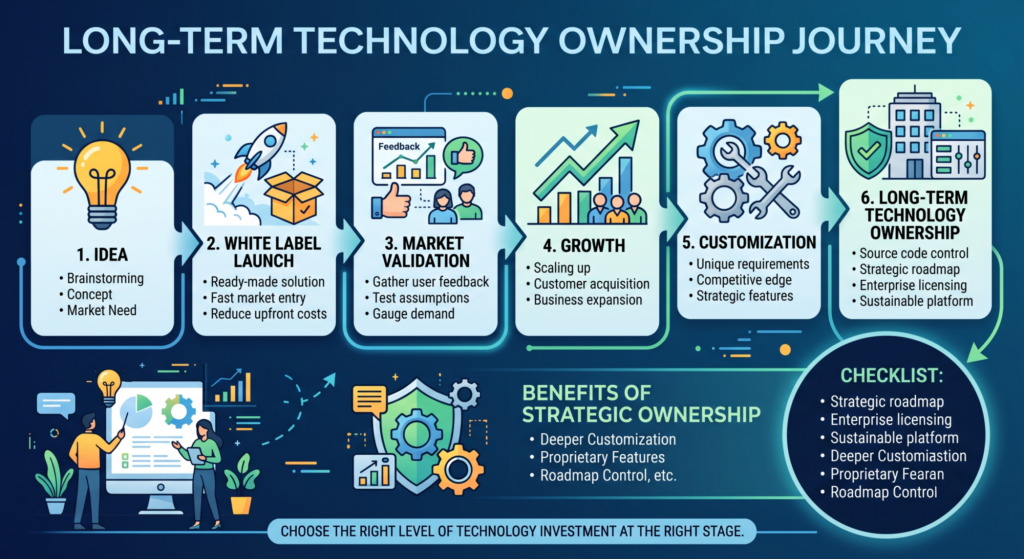
Long-Term Technology Ownership
Many operators begin with proven platforms to reduce risk and accelerate execution.
As businesses become established, operators may eventually consider:
- Enterprise licensing
- Deeper customization
- Proprietary features
- Source code ownership
- Long-term roadmap control
There is no single correct approach.
The important decision is choosing the right level of technology investment at the right stage of your business.
Checklist
Common Mistakes to Avoid
The Ultimate Launch Checklist
Before launching your poker platform, ask yourself:
Final Thoughts
Launching a real money poker platform in 2026 is no longer purely a technology challenge.
Modern technologies and proven platforms have significantly lowered the barriers to entry.
The real challenge lies in:
- Building communities
- Creating differentiated experiences
- Learning from players quickly
- Making smart technology decisions at the right time
The operators who succeed are often not the ones who build the most features first.
They are the ones who reach the market quickly, understand their players deeply, and continuously evolve their businesses over time.
Technology should quietly support that journey.