
If you’ve ever used poker software platforms such as PPPoker, PokerBros, ClubGG, or X-Poker, you may have wondered:
How do these poker game apps actually work behind the scenes?
To most players, these platforms appear to be simple mobile applications where players join tables and play poker with friends.
In reality, modern poker software platforms are far more sophisticated.
A successful poker game software is a complete technology ecosystem consisting of real-time multiplayer systems, game Hand Evaluators, cloud infrastructure, operational dashboards, financial reporting tools, and community management capabilities.
Understanding these components is important for poker operators, entrepreneurs, and gaming companies looking to launch or scale their own poker businesses.
Poker Software Is More Than Just a Mobile App
Modern poker software can be broadly divided into three major areas:
- Software Technology Components
- Cloud Infrastructure Components
- Operational & Business Components
All three work together to deliver the poker experiences that players interact with every day.
“Everything Required To Run A Modern Poker Platform”
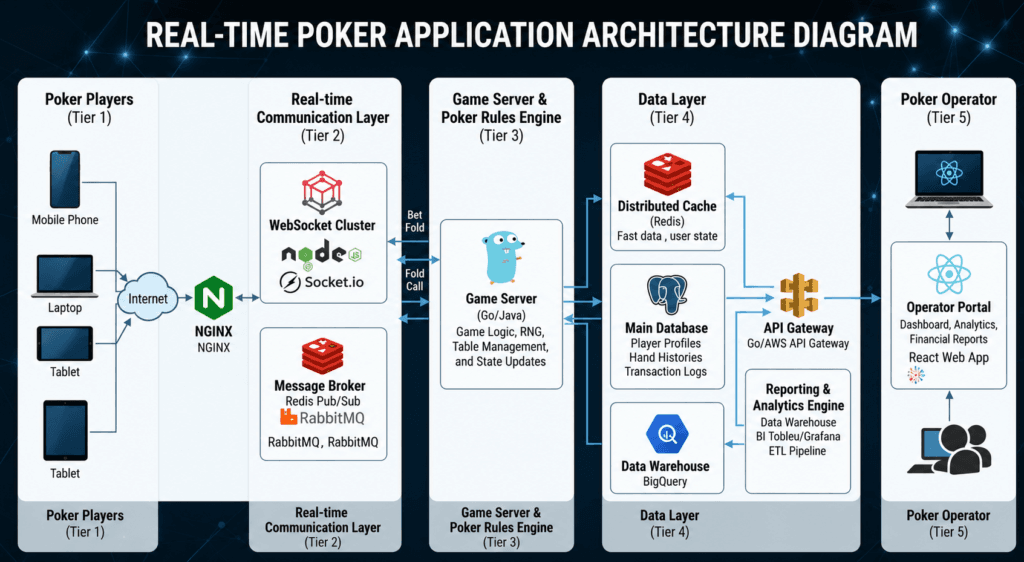
1. Software Technology Components
Game Client (Web, Android & iOS Applications)
The player-facing application is the part most people are familiar with.
This includes:
- Android applications
- iOS applications
- Web poker clients
These applications are typically built using technologies such as:
- Unity
- Cocos Creator
- Modern Web Technologies
The game client is responsible for:
- Rendering poker tables
- Displaying cards and chips
- Managing player interactions
- Showing tournament information
- Handling reconnect scenarios
- Delivering animations and player experiences
However, the game client itself contains very little poker logic.
Most of the actual intelligence exists on backend systems.
Real-Time Communication Layer
Poker is fundamentally a real-time multiplayer game.
Every player action must be synchronized instantly across all players at the table.
For example:
- A player joins a table
- Another player posts blinds
- A player raises
- The pot updates
- Cards are revealed
All connected players must see these updates almost immediately.
This is typically achieved using persistent real-time communication technologies such as WebSockets.
Without reliable real-time communication systems, poker experiences quickly become frustrating and unreliable.
Caching Layer
Modern poker systems process thousands of gameplay events every second.
Continuously reading and writing directly to databases can quickly become inefficient.
This is where caching technologies become important.
Caching systems are commonly used to store:
- Active table states
- Connected player sessions
- Tournament states
- Presence information
- Temporary gameplay data
For example:
When Player A raises ₹100, every player at the table should instantly see:
- Updated pot value
- New player balances
- Current turn information
Caching technologies help make these updates happen in real time.
Game Server
The game server acts as the operational heart of a poker platform.
Its responsibilities typically include:
- Creating and managing poker tables
- Processing player actions
- Synchronizing table states
- Managing tournaments
- Handling reconnections
- Enforcing gameplay rules
- Recording hand histories
Unlike traditional mobile applications, poker platforms require backend systems that continuously coordinate thousands of active players and tables simultaneously.
This is one of the reasons poker software is considerably more complex than traditional web applications.
Poker Rules Hand Evaluator (The Brain Behind Poker Software)
At the core of every poker software platform sits a poker rules Hand Evaluator.
This component is responsible for understanding how poker itself works.
Its responsibilities include:
- Hand evaluation
- Winner determination
- Side pot calculations
- Blind structures
- Tournament rules
- Hold’em and Omaha gameplay logic
- Split pots and showdown calculations
A reliable poker rules Hand Evaluator is one of the most critical components of any poker platform.
Even small mistakes in game logic can directly impact player trust and financial integrity.
At PokerInfra, our open-source Poker Kernel serves as one of the foundational technologies behind our poker ecosystem, helping power reliable and transparent poker experiences.
Why Poker Software Is Hard To Build
Poker platforms combine several difficult Hand Evaluatorering challenges into a single system:
- Real-time multiplayer gaming
- Financial transactions
- Tournament orchestration
- Fairness requirements
- Continuous uptime expectations
- Community management systems
Unlike many traditional applications, poker platforms are trust systems.
Players trust operators with:
- Their balances
- Tournament participation
- Game fairness
- Historical records
Operators trust technology providers to ensure stable and reliable gameplay experiences.
This is why building poker software requires highly specialized Hand Evaluatorering expertise.
2. Cloud Infrastructure Components
Once poker software starts attracting players, infrastructure becomes equally important.
Compute Infrastructure
Compute servers are responsible for running:
- APIs
- Real-time communication services
- Game servers
- Tournament services
- Reporting systems
- Administrative dashboards
As player communities grow, additional compute resources are often required.
Databases
Databases are used to store long-term information such as:
- User accounts
- Wallet balances
- Tournament records
- Hand histories
- Financial transactions
- Reporting information
- Community data
Data integrity becomes increasingly important as platforms scale.
Load Balancers
As player traffic increases, relying on a single server quickly becomes risky.
Load balancers distribute traffic across multiple services and servers.
This helps improve:
- Reliability
- Availability
- Performance
- Fault tolerance
Modern poker platforms often use distributed architectures to support large player communities.
Scalability
Infrastructure requirements vary significantly depending on player volume.
| Concurrent Players | Typical Infrastructure Requirements |
|---|---|
| 100 Players | Single Environment |
| 1,000 Players | Multiple Services |
| 10,000 Players | Distributed Architecture |
| 50,000+ Players | Highly Scalable Infrastructure |
Building systems that can scale gracefully is a critical part of modern poker technology.
3. Operational Components
Interestingly, a large portion of poker software has nothing to do with gameplay itself.
Much of the value for operators comes from operational systems.
Poker Room Management
Operators need tools to:
- Create poker rooms
- Configure table limits
- Manage club structures
- Create promotions
- Control rake settings
- Configure player permissions
Tournament Management
Modern poker platforms typically provide systems for:
- Scheduling tournaments
- Configuring blind structures
- Managing guarantees
- Prize distribution
- Tournament reporting
Tournaments often become one of the primary engagement mechanisms for growing poker communities.
Community Management
Successful poker businesses are ultimately community businesses.
Operational systems often include:
- Player management
- Club administration
- Agent management
- Membership systems
- Promotions and campaigns
- Player activity monitoring
Financial Reporting & Analytics
Financial visibility is extremely important for operators.
Modern poker software often includes reporting tools such as:
- Deposit reports
- Withdrawal reports
- Revenue analytics
- Rake reporting
- Agent commissions
- Settlement reports
- Player profitability reports
- Tournament financial reports
For many operators, these tools become just as important as the poker tables themselves.
How Modern Poker Platforms Work Together
When a player joins a table:
- The mobile application connects to real-time services.
- The game server authenticates the player.
- Table state is loaded from backend systems.
- Gameplay actions are synchronized between all players.
- The poker rules Hand Evaluator validates every action.
- Results are stored and reported through operational systems.
All of this happens within seconds.
This coordination between software, infrastructure, and operational tooling is what makes modern poker platforms possible.
Can You Launch Your Own Poker Platform?
Building all of these technologies independently can take years of Hand Evaluatorering effort and significant investment.
As a result, many operators choose to launch using a White Label Poker Platform, allowing them to focus on growing their communities while relying on proven technology foundations.
If you are considering launching your own poker platform, you may find these resources helpful:
Final Thoughts
Poker software is much more than a mobile application.
Behind every successful poker platform exists a sophisticated ecosystem of:
- Player applications
- Real-time multiplayer systems
- Poker game Hand Evaluators
- Cloud infrastructure
- Community management tools
- Financial reporting systems
As poker continues evolving toward online, live, and hybrid experiences, technology will increasingly become a strategic advantage for operators.
Choosing the right technology foundation today can significantly influence how easily operators adapt to the future of poker tomorrow.