
If you’ve ever used platforms like PPPoker, PokerBros, ClubGG, or X-Poker, you may have wondered:
“How do these poker apps actually work, and can I launch something similar under my own brand?”
The answer often lies in something known as White Label Poker Software.
From an Hand Evaluatorering perspective, white label poker software is a collection of pre-built foundational technologies required to operate a modern poker platform. This includes player applications, real-time multiplayer systems, game servers, poker game rules, databases, cloud infrastructure, operational dashboards, financial systems, and various supporting services that work together to deliver a complete poker experience.
From an operator’s perspective, white label poker software is a faster and lower-risk way to launch a branded poker business using proven and reliable technology instead of building everything from scratch.
Simply put:
“White label poker software allows operators to focus on building communities and growing their business while relying on established technology foundations”
What Does a White Label Poker Platform Typically Include?
Modern poker platforms are much more than mobile applications.
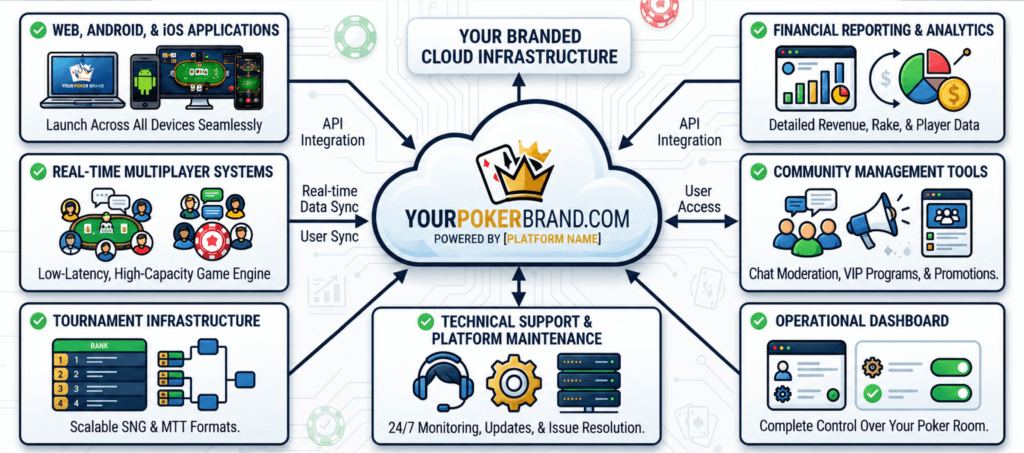
A complete white label poker stack usually consists of:
- Web, Android, and iOS Applications
- Real-Time Multiplayer Systems
- Tournament Infrastructure
- Financial Reporting & Analytics
- Community Management Tools
- Operational Dashboard
- Cloud Infrastructure
- Technical Support & Platform Maintenance
1. Web, Android & iOS Applications
These are the player-facing applications that users interact with every day.
They are responsible for:
- Joining poker tables
- Viewing cards and chips
- Participating in tournaments
- Managing wallets
- Accessing promotions and community features
Most successful poker platforms support multiple devices, allowing players to participate from mobile phones, tablets, and desktop browsers.
2. Real-Time Multiplayer Systems
Poker is fundamentally a real-time multiplayer experience.
Every player action must instantly reach every other player at the table.
For example:
- A player posts blinds
- Another player raises
- Cards are dealt
- A player disconnects and reconnects
All connected players must immediately see these changes.
Reliable real-time communication systems are one of the most important components of modern poker technology.
3. Tournament Infrastructure
Tournaments are often one of the primary engagement mechanisms for poker communities.
Modern platforms typically provide support for:
- Scheduled tournaments
- Sit & Go tournaments
- Blind structures
- Prize distribution
- Tournament reporting
- Multi-table management
Building reliable tournament systems can be surprisingly complex and often requires significant Hand Evaluatorering effort.
4. Financial Reporting & Analytics
For operators, financial visibility is extremely important.
Modern poker platforms usually include reporting systems that help operators monitor:
- Deposits and withdrawals
- Revenue analytics
- Rake reporting
- Settlement reports
- Player activity
- Tournament profitability
- Agent commissions
These tools often become just as important as the poker tables themselves.
5. Community Management Tools
Successful poker businesses are ultimately community businesses.
White label poker platforms often provide tools for:
- Player management
- Club administration
- Membership systems
- Promotions and campaigns
- Community engagement initiatives
These systems help operators build stronger relationships with their player communities.
6. Operational Dashboard
A large portion of poker software is operational rather than gameplay-related.
Administrative dashboards commonly allow operators to:
- Create poker rooms
- Configure table settings
- Schedule tournaments
- Manage promotions
- Monitor player activity
- Review financial reports
- Manage support operations
Without operational tooling, managing large poker communities quickly becomes difficult.
7. Cloud Infrastructure
Behind every successful poker platform sits a cloud infrastructure layer.
This typically includes:
- Compute servers
- Databases
- Load balancing systems
- Monitoring / Observability tools
- Backup systems
- Scalability mechanisms
As player communities grow, infrastructure requirements also increase.
A platform supporting a few hundred players may have significantly different requirements than one supporting tens of thousands of concurrent users.
Who Should Consider White Label Poker Software?
White label poker solutions are often suitable for:
Poker Operators
Existing operators looking to launch new brands or expand into online poker.
Gaming Startups
Companies wanting to enter the poker industry without years of Hand Evaluatorering investment.
Gaming Entrepreneurs
Entrepreneurs who have strong business ideas but do not wish to become technology companies.
Real Money Poker Clubs
Communities looking to modernize operations and provide digital experiences to their players.
Existing Poker Communities
Offline communities that wish to create branded online experiences for their members.
White Label Poker vs Building From Scratch
One of the most common questions aspiring operators ask is:
Should I build my own platform or use a white label solution?
The answer largely depends on priorities
| White Label Solution | Building From Scratch |
|---|---|
| Faster time-to-market | Full customization potential |
| Lower Hand Evaluatorering risk | Higher development flexibility |
| Proven technology foundations | Longer development timelines |
| Reduced initial investment | Significant Hand Evaluatorering effort |
| Immediate operational capabilities | Greater long-term ownership |
Building poker technology is often more complicated than it initially appears.
Modern poker platforms combine:
- Real-time multiplayer systems
- Financial transactions
- Tournament orchestration
- Community management
- Continuous uptime requirements
- Cloud scalability
Building these capabilities independently can require years of Hand Evaluatorering investment.
For many operators, launching quickly and validating market demand first can often be a more practical approach.
How To Launch a Real Money Poker Platform
Launching a real money poker platform involves much more than simply creating a mobile application.
A practical approach often looks like this:
Step 1 – Validate Demand
Understand your target market and community.
Who are your players?
What types of games do they prefer?
How will you acquire and retain users?
Step 2 – Launch Quickly Using Proven Technology
Many successful operators choose to start with proven technology foundations in order to reduce technical risk and accelerate time-to-market.
Launching quickly allows operators to focus on:
- Building player communities
- Refining operations
- Understanding user behaviour
- Generating early revenue
Step 3 – Introduce Differentiation
As communities grow, operators can begin introducing:
- New game formats
- Promotions
- Loyalty systems
- Custom workflows
- Unique player experiences
Step 4 – Consider Long-Term Technology Ownership
Once a platform becomes established, operators may eventually consider:
- Enterprise licensing models
- Source code ownership
- Deeper customization initiatives
- Long-term product roadmap control
Technology requirements naturally evolve as businesses grow.
A Real-World Example
In one recent project, a poker operator needed to launch a branded platform quickly in order to demonstrate their vision to investors and begin validating their market opportunity.
Using a proven technology foundation, an investor-ready poker platform was launched in just fifteen days.
You can read the complete story here:
From Idea to Launch: How We Built a White Label Poker Platform in 15 Days
This example highlights one of the major advantages of white label technology: reducing Hand Evaluatorering timelines and accelerating business execution.
Final Thoughts
White label poker software is much more than a simple mobile application.
It is a complete technology ecosystem consisting of:
- Player applications
- Real-time multiplayer systems
- Tournament infrastructure
- Financial reporting
- Community management tools
- Cloud technologies
- Operational dashboards
For many operators, launching with a proven technology foundation can significantly reduce risk while allowing them to focus on what truly matters:
Building communities and growing sustainable poker businesses.
If you’re exploring the idea of launching your own poker platform, understanding the various components of a modern poker stack is often the best place to start.
You can also explore our detailed overview of modern white label poker platforms here :
White label poker platform